The Numbers Don't Lie: How America's Worst Math Student Built the Digital Future
The Boy Who Couldn't Count
Claude Shannon's teachers had given up on him by the time he reached high school. The scrawny kid from rural Michigan couldn't seem to grasp basic mathematical concepts that came naturally to his classmates. He failed algebra twice, struggled through geometry, and showed no particular aptitude for the logical thinking that mathematics demanded. His guidance counselor suggested he consider a career in manual labor.
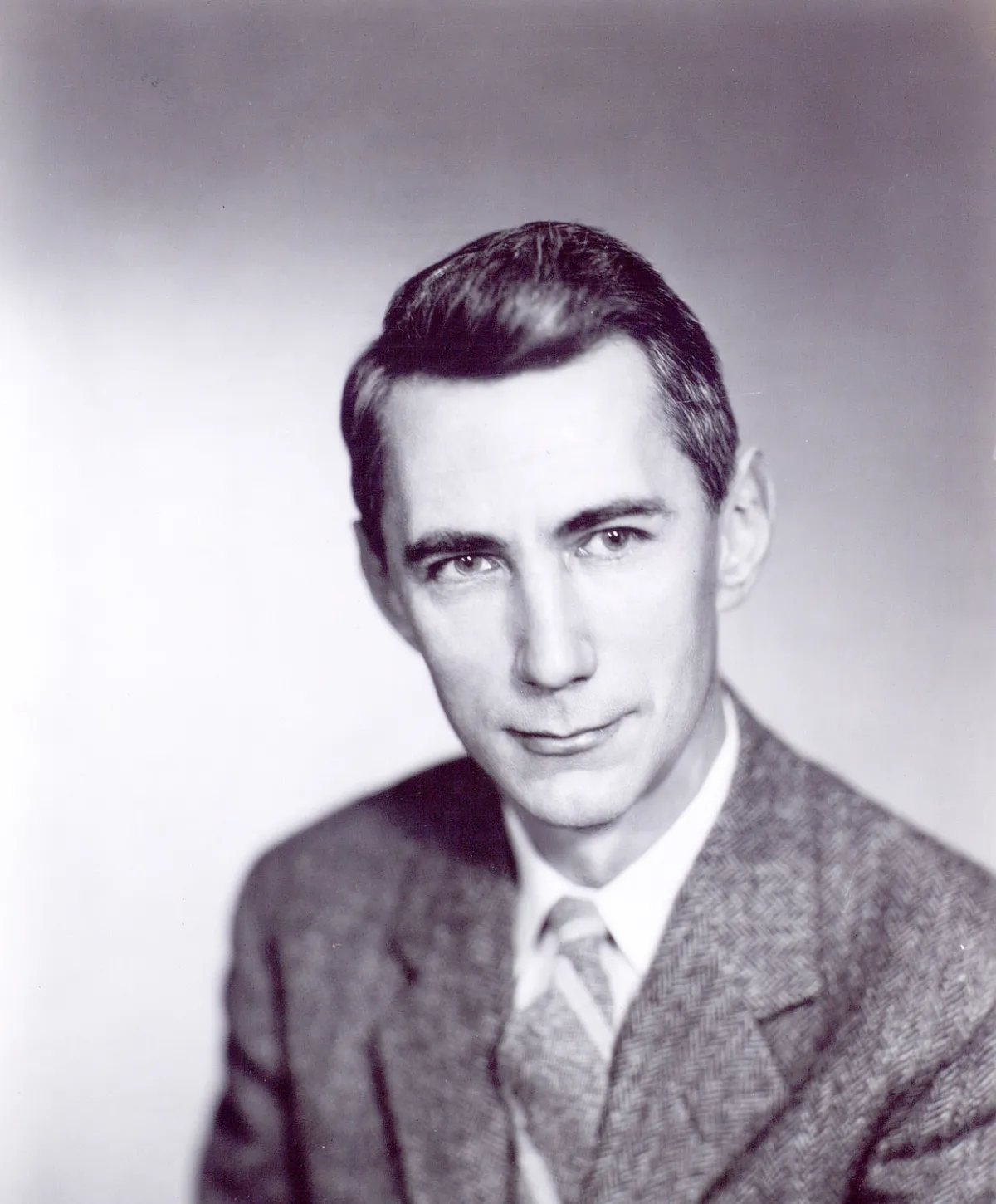 Photo: Claude Shannon, via www.bostonreview.net
Nobody could have predicted that this mathematically challenged teenager would eventually create the theoretical framework that makes every digital device on Earth possible. Shannon's journey from academic failure to technological prophet is one of the most improbable success stories in American history—and a reminder that genius rarely announces itself in conventional ways.
The Tinkerer's Mind
While Shannon struggled with classroom mathematics, he possessed a different kind of intelligence that his teachers couldn't recognize or measure. He spent hours in his family's garage, taking apart radios, building telegraph systems, and creating elaborate mechanical contraptions that served no practical purpose but fascinated him endlessly.
His neighbors thought he was wasting time. His parents worried he'd never amount to anything. But Shannon was developing something more valuable than mathematical fluency: an intuitive understanding of how information moves through systems. He could see patterns in mechanical relationships that wouldn't be formalized in mathematics for decades.
At Gaylord High School in northern Michigan, Shannon's grades remained mediocre. He showed more interest in the school's amateur radio club than any of his academic subjects. Teachers noted his distractibility and poor performance in core subjects. Nobody suggested he might be college material.
The Accidental Scholar
Shannon's path to higher education was pure chance. A family friend mentioned that the University of Michigan offered scholarships for students willing to work their way through school. Shannon applied not because he was academically ambitious, but because he needed something to do after graduation and couldn't afford college any other way.
 Photo: University of Michigan, via soofosnl.b-cdn.net
Michigan's admissions standards were more flexible in the 1930s than they would become later. Shannon squeaked in with mediocre grades and immediately gravitated toward electrical engineering—not because he understood the mathematics behind it, but because it involved the kinds of mechanical systems he'd been tinkering with since childhood.
Even in college, Shannon's academic performance remained unremarkable. He earned C's in most of his mathematics courses and showed little interest in theoretical work. Professors noted his tendency to daydream and his preference for hands-on projects over abstract problem-solving.
The Breakthrough Nobody Noticed
Shannon's transformation began almost by accident during his graduate work at MIT. Assigned to work with Vannevar Bush's differential analyzer—an early mechanical computer—Shannon became fascinated not with the machine's calculations but with its logical operations. He began to see connections between electrical circuits and symbolic logic that nobody had noticed before.
Working alone in the basement laboratory, Shannon developed ideas that would eventually become information theory—the mathematical foundation of all digital communication. But his insights emerged not from advanced mathematical training but from his intuitive understanding of mechanical systems combined with an outsider's perspective on formal logic.
His master's thesis, "A Symbolic Analysis of Relay and Switching Circuits," was completed in 1937 with little fanfare. The work showed how Boolean algebra could be used to optimize electrical circuits, laying the groundwork for all future digital computers. But the implications weren't immediately obvious to anyone, including Shannon himself.
The War That Changed Everything
World War II transformed Shannon from an obscure graduate student into one of America's most important theoretical minds. Working at Bell Labs on cryptography and communication systems, he encountered problems that required exactly the kind of unconventional thinking that had made him seem like a poor student.
 Photo: Bell Labs, via opensource.com
Traditional mathematicians approached communication problems by trying to eliminate uncertainty and noise. Shannon took the opposite approach: he embraced uncertainty as a fundamental property of information itself. This counterintuitive insight—that information and uncertainty are mathematically equivalent—became the foundation of information theory.
His colleagues at Bell Labs initially dismissed his work as too abstract to be useful. Shannon was studying the theoretical limits of communication systems, while they needed practical solutions to immediate engineering problems. But Shannon's "useless" theories would eventually make possible every advance in digital technology over the next seventy years.
The Paper That Built the Future
In 1948, Shannon published "A Mathematical Theory of Communication" in the Bell System Technical Journal. The paper was dense, mathematical, and seemingly irrelevant to most readers. It attracted little attention outside a small circle of communication engineers and mathematicians.
But Shannon's paper contained ideas that would reshape human civilization. He had created a mathematical framework for understanding information itself—showing how any kind of information could be converted into binary digits, transmitted through noisy channels, and reconstructed perfectly at the receiving end.
The concepts Shannon developed—bits, bandwidth, entropy, redundancy—became the vocabulary of the digital age. Every computer, smartphone, internet connection, and digital storage device operates according to principles Shannon outlined in that overlooked paper.
The Reluctant Prophet
Shannon himself seemed surprised by the impact of his work. He had approached information theory as an intellectual puzzle rather than a practical tool. When computer scientists and engineers began applying his theories to build digital systems, Shannon often expressed amazement that his abstract mathematics had real-world applications.
He remained an unconventional figure throughout his career—more interested in juggling, unicycling, and building mechanical toys than in promoting his revolutionary ideas. While others built the digital industries based on his theories, Shannon continued tinkering in his home workshop, creating whimsical machines that served no purpose beyond his own amusement.
The Foundation Beneath Everything
Today, Shannon's work underlies virtually every aspect of modern life. The smartphone in your pocket, the WiFi network in your home, the GPS system in your car, the streaming video on your television—all depend on mathematical principles that Shannon developed while struggling through basic algebra as a teenager.
Internet search engines use Shannon's concepts to compress and transmit information. Social media platforms apply his theories to optimize data flow. Financial markets rely on his insights for high-frequency trading. Even biological research now uses information theory to understand how genetic information is stored and transmitted.
The Lesson of the Wrong Path
Claude Shannon's story challenges fundamental assumptions about how genius develops and how innovation happens. The boy who couldn't pass algebra became the architect of the information age not despite his unconventional path, but because of it.
His mathematical struggles forced him to develop intuitive approaches to complex problems. His outsider status allowed him to see connections that trained mathematicians missed. His practical tinkering gave him insights into how systems actually work rather than how they're supposed to work in theory.
Perhaps most importantly, Shannon's story suggests that the most transformative ideas often come from people who don't fit conventional molds. The student who struggles with established methods might be developing entirely new ways of thinking. The mind that seems poorly suited to existing frameworks might be perfectly designed to create new ones.
In an age increasingly focused on standardized testing and conventional metrics of academic success, Shannon's journey reminds us that genius takes many forms—and sometimes the most important discoveries come from the minds that everyone else has written off.
The wrong path through mathematics led Shannon to the right destination: a theoretical framework that made the modern world possible. His legacy suggests that sometimes the best way to predict the future is to stop trying to fit into the present.