No Degree Required: Seven American Landmarks Built by People Who Had No Business Building Them
The American story has always had a complicated relationship with credentials. On one hand, the country built institutions — universities, licensing boards, professional guilds — designed to ensure that the people doing important work actually knew what they were doing. On the other hand, some of the most enduring things ever built on American soil were designed and constructed by people those institutions would never have let through the front door.
These are seven of them.
1. The Watts Towers, Los Angeles — Sabato Rodia
Sabato Rodia was an Italian immigrant tile worker who, in 1921, began building something in his backyard in the Watts neighborhood of Los Angeles. He had no architectural training, no engineering degree, no construction crew, and no blueprint. What he had was time, obsession, and an inexhaustible appetite for discarded materials.
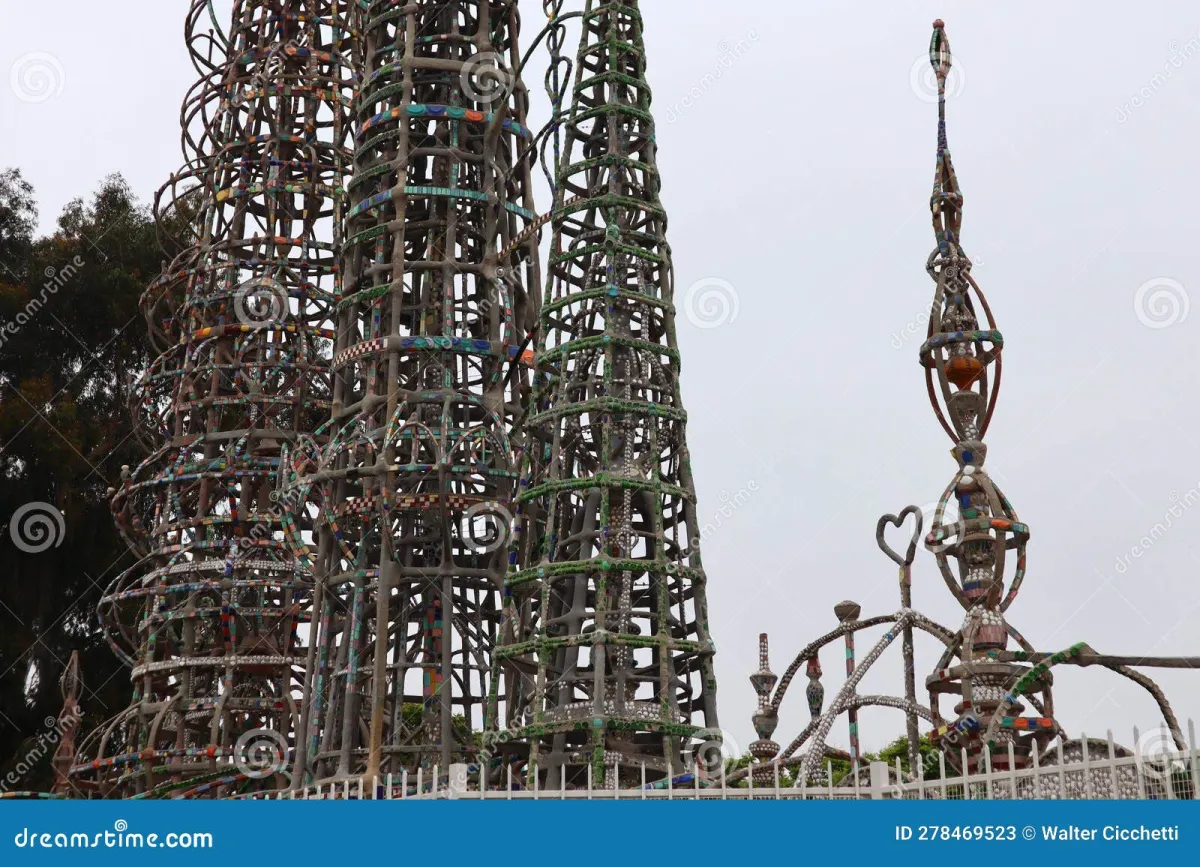 Photo: Watts Towers, via thumbs.dreamstime.com
Over thirty-three years, working entirely alone and entirely after hours, Rodia built seventeen interconnected spires out of steel rebar, wire mesh, mortar, and whatever he could find — broken tile, seashells, glass bottles, pottery shards, corncobs. The tallest tower reaches nearly one hundred feet. The entire structure is decorated with mosaics assembled from found objects with a density and intricacy that professional artists have spent careers trying to understand.
When city engineers finally inspected the towers in 1959 — partly in response to neighbors who wanted them torn down — they subjected the structure to a lateral load test designed to pull it apart. The towers held. The testing rig failed first.
Rodia had given the property away and moved to Northern California years before the test. He reportedly never returned to see what he'd built. The Watts Towers are now a National Historic Landmark. They will almost certainly outlast everything else built in that neighborhood.
2. The Winchester Mystery House, San Jose — Sarah Winchester
Sarah Winchester was an heiress, a widow, and, depending on who you ask, either a grieving eccentric or a woman who simply decided that her house would never be finished. After the death of her husband William Winchester — heir to the rifle fortune — she moved to San Jose and began a construction project that lasted thirty-eight years and produced one of the strangest buildings in the United States.
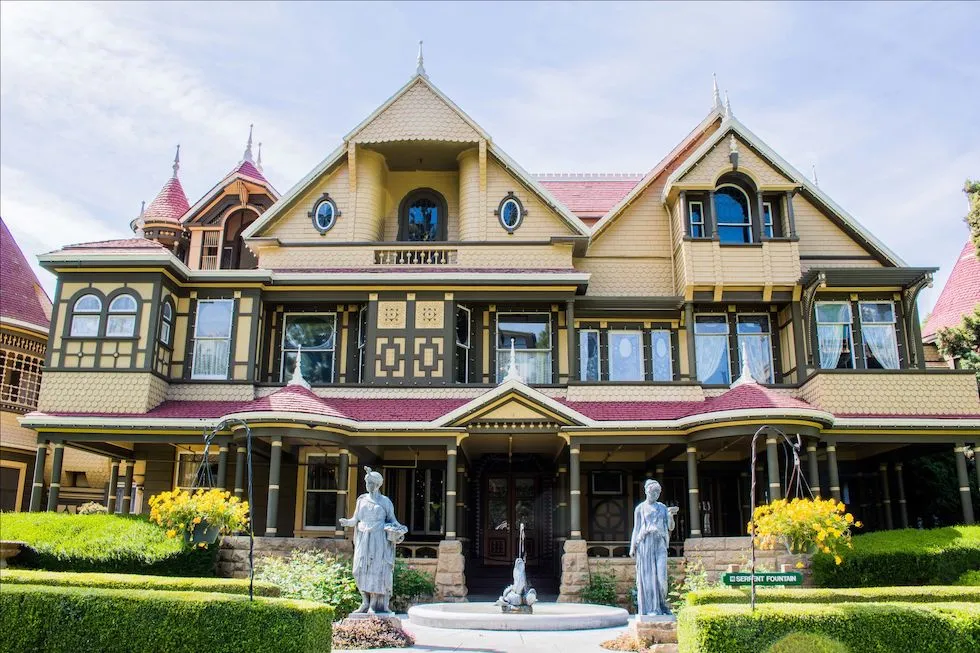 Photo: Winchester Mystery House, via attractionsmagazine.com
She had no architectural training. She designed rooms herself, sometimes sketching plans on paper, sometimes on tablecloths. She employed teams of carpenters around the clock, and the results were — unusual. Stairs that lead into ceilings. Doors that open onto two-story drops. Windows built into interior floors. Chimneys that stop just short of the roof. The house eventually contained one hundred sixty rooms, forty-seven fireplaces, and a layout that defies any conventional logic of domestic space.
Professional architects who have studied the house extensively disagree about whether Winchester was guided by superstition, grief, a genuine design philosophy, or something stranger still. What they don't disagree about is that the craftsmanship throughout is exceptional — the woodwork, the art glass, the parquet floors. Whatever she was doing, she was doing it with real skill and real resources.
The Winchester Mystery House is now one of California's most visited historic attractions. More than a million people tour it every year. No licensed architect has ever quite explained it.
3. Coral Castle, Homestead, Florida — Edward Leedskalnin
Edward Leedskalnin stood five feet tall, weighed a hundred pounds, and had a fourth-grade education. Between 1923 and 1951, working entirely alone and almost always at night, he quarried, moved, and assembled approximately one thousand one hundred tons of coral rock into an elaborate sculpture garden and home in South Florida.
He never explained how he did it. He refused to let anyone watch him work. Engineers and physicists who have studied the site — including the massive stones he moved without any visible heavy equipment — have never reached a consensus on the mechanics involved. Some of the individual pieces weigh thirty tons.
Leedskalnin called his creation Rock Gate Park. He charged visitors ten cents for a tour. After his death, it was renamed Coral Castle, and it has been drawing curious visitors ever since. It is listed on the National Register of Historic Places.
The man had no training, no crew, and no explanation. He had a broken engagement (the project was reportedly built for the woman who jilted him), a set of tools he fashioned himself, and a level of physical determination that remains genuinely difficult to account for.
4. The Brooklyn Bridge, New York — Emily Warren Roebling
The Brooklyn Bridge is perhaps the most famous American example of an amateur — or at least an uncredentialed one — stepping into a role they were never supposed to fill and producing something immortal.
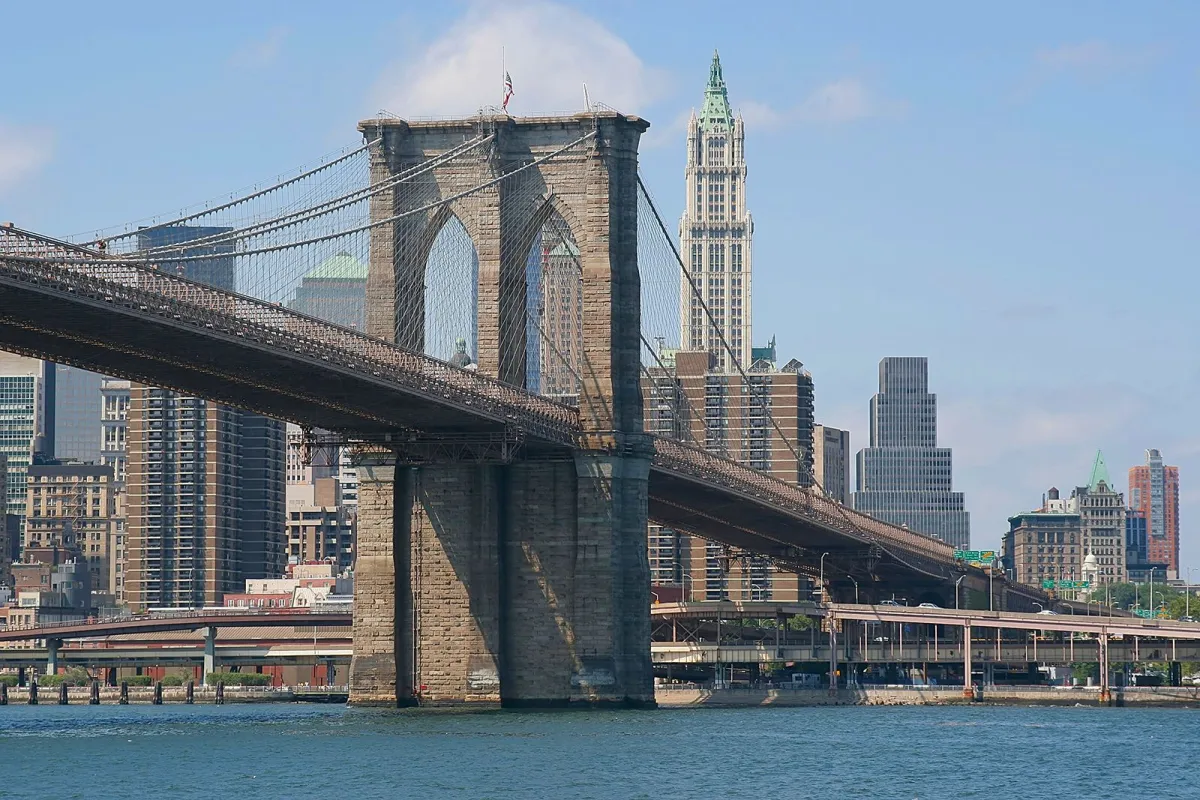 Photo: Brooklyn Bridge, via cdn.britannica.com
When chief engineer Washington Roebling was struck by decompression sickness in 1872 and left largely bedridden, the project faced a crisis. His wife, Emily Warren Roebling, stepped in. She had no engineering degree. Women weren't admitted to engineering programs in the 1870s. What she had was a husband who could teach her, a mind that absorbed mathematics and structural theory with alarming speed, and the organizational will to run a massive, complex construction project from the parlor of her home.
For eleven years, Emily was the effective face of the Brooklyn Bridge's construction. She communicated daily with the engineers on site, interpreted Washington's instructions, handled political negotiations, and developed enough technical expertise that some historians argue she should be considered a co-engineer of the project.
When the bridge opened in 1883, Emily was the first person to cross it — carrying a rooster as a symbol of victory. The professional engineers who had questioned her authority for over a decade watched from the crowd.
5. Fallingwater, Mill Run, Pennsylvania — Frank Lloyd Wright (Sort Of)
Frank Lloyd Wright had no conventional architectural degree. He studied civil engineering briefly at the University of Wisconsin, left without graduating, and learned the rest by working under Louis Sullivan in Chicago. He had no license in the standard sense when he began practicing independently.
He was also, by the time he designed Fallingwater in 1935, considered washed up. His career had stalled. He hadn't completed a significant commission in years. When Pittsburgh department store magnate Edgar Kaufmann Sr. hired him to design a vacation home over a waterfall in rural Pennsylvania, many in the architectural establishment considered it an act of misplaced nostalgia.
The result was Fallingwater — a cantilevered masterwork that the American Institute of Architects has repeatedly named the greatest work of American architecture of the twentieth century. It was built by a man the profession had largely written off, using structural approaches his contemporaries considered reckless. The cantilevers did, in fact, sag over time — but the house still stands, still stuns, and still draws more than a hundred thousand visitors a year.
The structural engineers who worried about it were not wrong. They just weren't entirely right either.
6. The Forestiere Underground Gardens, Fresno — Baldassare Forestiere
Baldassare Forestiere came to California from Sicily in 1901 expecting fertile land. What he got was a hardpan crust in the San Joaquin Valley that defeated every conventional attempt at farming. Rather than give up or move on, he went underground.
Over the next forty years, working alone with hand tools, Forestiere excavated more than ten acres of tunnels, grottos, and underground rooms beneath his property — creating a subterranean world that included living quarters, a fish pond, a chapel, and an elaborate garden where he grew citrus trees through skylights he cut in the ceiling. He had no training in excavation or structural engineering. He designed everything himself, guided by observation, instinct, and the logic of the hardpan itself.
The Forestiere Underground Gardens are now a California Historical Landmark. Structural engineers who have assessed the site consistently express amazement that the tunnels — built without rebar or formal support systems — have remained stable for over a century.
Forestiere reportedly hoped to open the gardens as a resort. He never quite finished. He died in 1946, still digging.
7. The Ave Maria Grotto, Cullman, Alabama — Brother Joseph Zoettl
Joseph Zoettl arrived in Alabama from Bavaria in 1892 as a Benedictine monk. He was small, hunchbacked, and worked in the abbey's powerhouse for most of his adult life. He had no artistic training beyond what he'd absorbed as a child, and no particular reason to believe he had anything monumental to contribute to the world.
He began building miniature replicas of famous religious and historical structures in his spare time, using concrete, broken glass, marbles, cold cream jars, and whatever else he could scavenge. Over the course of decades, he built one hundred twenty-five miniature structures — including scale models of St. Peter's Basilica, the Pantheon, the Colosseum, and the Leaning Tower of Pisa — and arranged them across a four-acre hillside garden.
The Ave Maria Grotto opened to the public in 1934 and has been drawing visitors ever since. It is listed on the National Register of Historic Places and described by the American Visionary Art Museum as one of the great examples of American outsider art.
Brother Joseph worked on it until he was too old to continue. He reportedly never considered himself an artist. He was just a monk who liked to build things.
What They Built, and What It Means
None of these people had permission. Not the kind that comes with a diploma on the wall or a license from a professional board. What they had instead was something harder to quantify and considerably more difficult to teach: the refusal to accept that the absence of credentials was the same as the absence of ability.
The American built environment is full of monuments to that refusal. Some of them are on the National Register of Historic Places. Some of them are studied by engineers who still can't fully explain them. All of them were built by people somebody, somewhere, told to stop.
They didn't stop. That's the whole story.