Against All Orders: The Small-Town Teacher Who Rewrote the Rules of American Exploration
The Expedition That Left Without Her
In 1889, a 25-year-old schoolteacher from upstate New York stood on the platform of the Santa Fe railroad station, watching the scientific expedition she'd begged to join disappear into the distance without her. The team leader had been polite but firm: wilderness fieldwork was dangerous, uncomfortable, and entirely unsuitable for ladies.
Florence Merriam Bailey bought a ticket on the next train heading west.
 Photo: Florence Merriam Bailey, via www.followmeaway.com
What the expedition leaders didn't realize was that they'd just made the biggest mistake in the history of American ornithology. The woman they'd left behind would go on to write the field guides that introduced millions of Americans to their own backyard wildlife, pioneering observation techniques that are still used by scientists today.
The Unlikely Naturalist
Bailey's path to becoming America's most fearless field researcher began not in the wilderness, but in the comfortable parlors of Locust Grove, New York, where proper young ladies were expected to pursue genteel hobbies like watercolor painting and pressed flower collecting. Her family had money, education, and clear expectations about what their daughter's life should look like.
But Bailey was cursed with an incurable case of curiosity. While her classmates at Smith College were studying literature and languages, she was sneaking out at dawn to watch birds in the campus woods, filling notebook after notebook with detailed observations about their behavior, their calls, their nesting patterns.
 Photo: Smith College, via www.biorock-indonesia.com
Her professors were charmed but concerned. Natural history was a fascinating hobby for an educated woman, but hardly a career. The serious scientific work—the expeditions, the research, the publications that actually mattered—was men's territory.
Bailey listened politely to their advice. Then she ignored every word of it.
Going Solo Into the Unknown
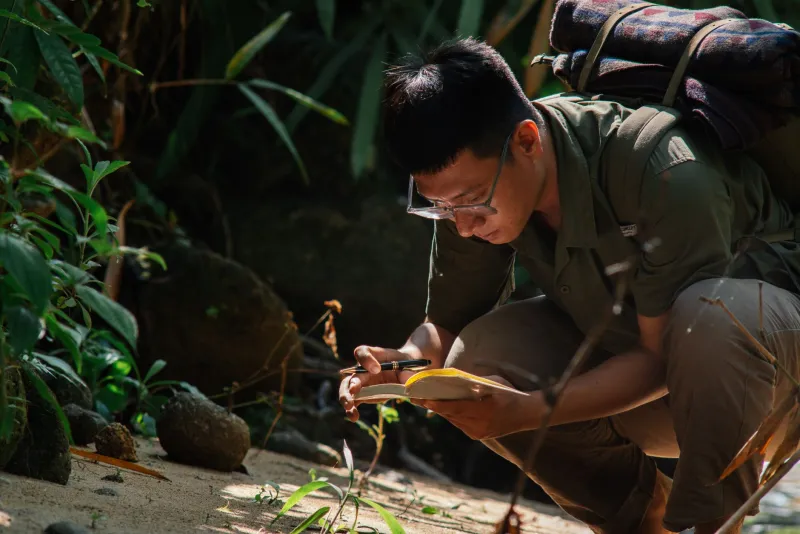
When the scientific establishment refused to take her seriously, Bailey decided to take herself seriously instead. In 1889, she used her inheritance to fund her own expedition to California, traveling alone into the Sierra Nevada mountains with nothing but camping gear, field notebooks, and an unshakeable belief that the best way to study birds was to live among them.
Her approach was revolutionary for its simplicity. While male ornithologists were still relying heavily on specimen collection—shooting birds to study them in laboratories—Bailey developed techniques for observing living birds in their natural habitats. She learned to move quietly through forests, to recognize individual birds by their unique markings, to document behavior patterns that could only be seen in the wild.
The notes she kept during those early solo expeditions read like dispatches from an undiscovered country: detailed descriptions of bird communities that no scientist had ever systematically observed, behavioral patterns that challenged existing theories, ecological relationships that revealed how deeply interconnected the natural world really was.
The Teacher Becomes the Authority
Bailey's first book, "Birds Through an Opera Glass," published in 1889, was unlike anything that had been written about American wildlife. Instead of dry scientific descriptions, she wrote with the enthusiasm of someone who genuinely loved what she was studying. Instead of focusing on dead specimens, she brought readers into the living world of birds—their personalities, their family dramas, their daily routines.
The book was an instant success, but Bailey was just getting started. Over the next decade, she embarked on increasingly ambitious solo expeditions, traveling to remote corners of the American West that most professional naturalists had never seen. She spent months at a time living in rough camps, documenting species that existed nowhere else in the world.
Her 1902 masterpiece, "Handbook of Birds of the Western United States," became the definitive guide to Western American birds for the next fifty years. The book was based on thousands of hours of direct field observation, illustrated with her own sketches and photographs, and written in clear, accessible language that made complex scientific information understandable to amateur naturalists.
Changing How America Saw Itself
Bailey's work arrived at a crucial moment in American history. The country was rapidly industrializing, cities were growing, and many Americans were losing touch with the natural world their grandparents had known intimately. Her field guides gave urban readers a way to reconnect with nature, even if they only had access to city parks or suburban backyards.
But Bailey's influence went beyond birdwatching. Her detailed ecological observations helped establish the scientific foundation for America's early conservation movement. She documented how human activities were affecting wildlife populations, tracked the spread of invasive species, and identified critical habitats that needed protection.
Her work was particularly important in the American West, where rapid development was transforming landscapes faster than scientists could study them. Bailey's expeditions preserved crucial baseline data about ecosystems that would soon be dramatically altered by mining, logging, and agriculture.
The Recognition That Came Too Late
By the 1920s, Bailey had become the most respected field ornithologist in America, but the recognition came with a bitter irony. The same scientific institutions that had excluded her in her youth were now eager to claim her as their own. She received honorary degrees from universities that had once refused to admit women to their graduate programs. She was elected to scientific societies that had spent decades arguing that fieldwork was too demanding for female constitutions.
Bailey accepted the honors graciously, but she never forgot the years she'd spent working alone, funding her own research, and fighting for every opportunity to do the work she loved. In her later writings, she encouraged young women to pursue their scientific interests regardless of institutional barriers, reminding them that the natural world didn't care about human prejudices—it only cared about careful observation and honest reporting.
The Maps She Drew
When Florence Merriam Bailey died in 1948, she left behind more than just field guides and scientific papers. She had fundamentally changed how Americans understood their relationship with the natural world around them. Her books had taught millions of people to see birds not as distant, exotic creatures, but as neighbors whose lives were intimately connected to human communities.
Perhaps most importantly, she had proven that the most valuable scientific discoveries often come from the people who are told they don't belong. The expeditions that left without her missed out on insights that could only come from someone willing to sit quietly in the wilderness, watching and waiting and taking notes until the hidden patterns of the natural world revealed themselves.
The woman who was deemed too delicate for fieldwork had spent six decades tramping through some of the most challenging terrain in North America, producing scientific work that outlasted most of her male contemporaries. She had drawn maps of a country that most Americans didn't even know existed—the wild, complex, endlessly fascinating world that was hiding in plain sight, waiting for someone patient enough to really look.