He Was Hired to Sweep Floors. He Left Behind a Scientific Revolution.
The Night Shift Education
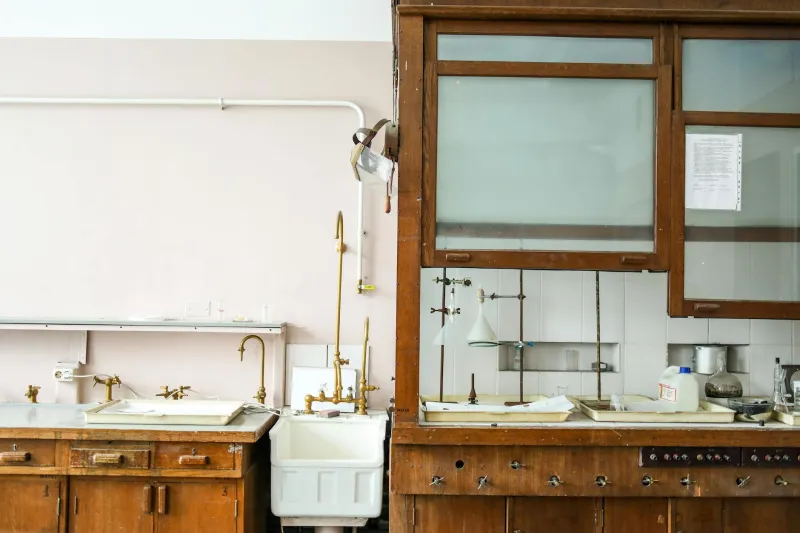
Every evening at 6 PM, when the last researcher locked their laboratory and headed home, Michael Faraday's real education began. Officially, he was employed by the Royal Institution of London to sweep floors, empty trash bins, and keep the building clean. Unofficially, he was conducting one of history's most remarkable self-directed scientific educations.
 Photo: Royal Institution of London, via cdn.observatoriodocinema.com.br
 Photo: Michael Faraday, via topi.it
Faraday had been hired in 1813 at age 21, after his apprenticeship as a bookbinder ended. He had no formal schooling beyond basic reading and arithmetic, no scientific training, and no connections in London's intellectual circles. What he did have was an insatiable curiosity and access to empty laboratories filled with equipment he wasn't supposed to touch.
The Invisible Advantage
While credentialed scientists worked during the day under the watchful eyes of their peers and supervisors, Faraday had something they lacked: complete freedom to fail. No one was monitoring his experiments because no one expected him to be conducting any.
He spent his nights reading scientific papers left behind on desks, copying diagrams, and attempting to recreate experiments he'd observed during his cleaning rounds. When equipment broke during his amateur attempts, he taught himself to repair it. When he couldn't understand complex mathematical proofs, he developed intuitive approaches that often proved more elegant than the formal methods.
This invisible status became his greatest asset. He could ask naive questions that established scientists wouldn't dare voice. He could pursue hunches that seemed too simple or obvious for serious consideration. Most importantly, he could fail repeatedly without damaging his reputation—because he didn't have one to protect.
The Breakthrough in the Basement
Faraday's moment of discovery came in 1831, during one of his unauthorized late-night sessions in the basement laboratory. He was investigating the relationship between electricity and magnetism, a question that had puzzled scientists for decades.
Using equipment he'd assembled from spare parts and materials he'd "borrowed" from various departments, Faraday wrapped two coils of wire around opposite sides of an iron ring. When he connected one coil to a battery, he noticed that a compass needle near the second coil moved—but only at the moment when he connected or disconnected the power.
This observation led to his discovery of electromagnetic induction, the principle behind every electric generator and transformer in use today. The revelation came not from complex mathematical calculations or expensive equipment, but from patient observation and a willingness to notice what others had overlooked.
From Janitor to Genius
Word of Faraday's discovery spread quickly through London's scientific community. The same researchers who had barely acknowledged his presence during the day suddenly wanted to understand his work. His lack of formal education, once a barrier, became an advantage—his explanations were clear and accessible because he'd never learned to hide behind academic jargon.
Within two years, Faraday was promoted from janitor to laboratory assistant, then to lecturer, and finally to the institution's first Fullerian Professor of Chemistry. He never earned a university degree, but he revolutionized the field of electromagnetism and laid the groundwork for the modern electrical age.
His laboratory notebooks, filled with careful observations and hand-drawn diagrams, became the foundation for countless technological innovations. The electric motors that power our appliances, the generators that supply our electricity, and the transformers that deliver power to our homes all trace their origins to experiments conducted by a night-shift janitor who wasn't supposed to be doing science.
The Ripple Effect of Invisible Work
Faraday's story illuminates something profound about innovation: breakthrough discoveries often come from unexpected sources. While established scientists were constrained by academic hierarchies and professional expectations, an outsider with a mop and bucket was free to pursue pure curiosity.
His success also highlights how institutional access matters more than institutional approval. Faraday didn't need permission to use the equipment—he just needed to be in the building when no one was watching. His janitorial position, which seemed like a dead end, actually provided him with resources that most aspiring scientists of his era could never afford.
The Legacy of Learning After Hours
Today, Faraday's laws of electromagnetism are taught in every physics classroom around the world. His experimental methods influenced generations of scientists who learned to value careful observation over theoretical speculation. The Royal Institution still bears his name on its most prestigious lecture hall.
But perhaps his most important legacy is the reminder that scientific progress doesn't always come from the people we expect. Sometimes it comes from the person emptying the wastebaskets, the one who has access but not permission, the outsider who asks questions that insiders have learned not to ask.
The Wrong Path to the Right Discovery
Faraday's journey from bookbinder to janitor to scientific revolutionary proves that the most important qualifications for discovery might be curiosity and persistence rather than credentials and connections. His wrong path—taking a menial job instead of pursuing formal education—led him to insights that transformed the world.
In laboratories across the country, night-shift workers still clean around expensive equipment and complex experiments. Faraday's story suggests we should wonder: what discoveries might be waiting for someone brave enough to ask questions they're not supposed to know how to answer?
Sometimes the most revolutionary science happens after everyone else has gone home.