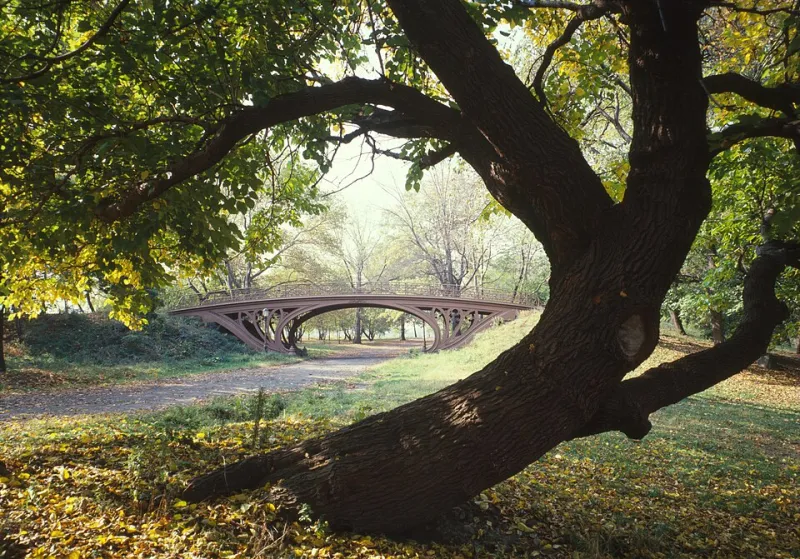
Photo: Jet Lowe, Public domain, via Wikimedia Commons
In 1857, a 35-year-old man with no formal training in design, engineering, or horticulture submitted a competition entry for a new park in the middle of Manhattan. He'd spent his adult years failing at farming, writing travel journalism, and running a publishing house that went bankrupt. He had no credential that should have qualified him for the job.
He won anyway.
And then he spent the next four decades designing the public spaces that would define the American experience of cities—from the hills of Brooklyn to the lakefront of Chicago to the grounds surrounding the United States Capitol. Frederick Law Olmsted didn't come to landscape architecture through the front door. He came through a side entrance nobody else had noticed, carrying something more valuable than a degree: a lifetime of watching how ordinary people actually used the spaces around them.
A Career Built From Wreckage
The biography of Frederick Law Olmsted reads, for its first three decades, like a cautionary tale about a man who couldn't settle down. He tried dry goods. He tried scientific farming on Staten Island, convinced he could revolutionize American agriculture through careful observation and methodical practice. He didn't revolutionize anything, but he did develop a habit of watching systems—how soil responded, how drainage patterns shaped growth, how small changes in terrain created entirely different environments.
He traveled through the American South in the early 1850s, writing dispatches for the New York Times about the social and economic conditions he observed. The resulting books—still read today as primary documents of antebellum America—revealed a man with an unusual gift: he could walk through a place and understand it structurally, could see how the physical landscape shaped the human behavior happening within it.
Then the publishing house failed. Then the farming operation wound down. And then, almost accidentally, he heard about a competition for a new public park in New York City.
The Competitive Disadvantage That Wasn't
The competition for Central Park drew 33 entries. Most came from trained engineers and horticulturalists with established practices and professional pedigrees. Olmsted partnered with Calvert Vaux, a British-trained architect, and together they submitted a plan called the Greensward Plan—a design that, in retrospect, looks less like a park proposal and more like a piece of social philosophy rendered in topography.
What separated Olmsted's entry from the competition wasn't technical sophistication. It was observation. He had spent weeks walking the existing site, noting how people moved through it, where they gathered naturally, where they didn't. He understood that a park in the middle of a dense city wasn't primarily a horticultural project. It was a psychological one. People didn't need more nature in the abstract. They needed specific kinds of space: places where the city disappeared from view, where the noise dropped away, where the scale shifted from the compressed grid of Manhattan to something that felt, however briefly, like open countryside.
The designers with formal training were solving an engineering problem. Olmsted was solving a human one.
They won the competition. Construction began in 1858.
The Method Behind the Meadows
Building Central Park was an act of staggering ambition. The site was swampy, rocky, and occupied by several hundred residents who had to be displaced. Olmsted managed a workforce that eventually reached 3,800 laborers, coordinating blasting, grading, planting, and drainage across 843 acres. He had never managed anything at that scale before.
What he brought to the management of it was the same quality he'd brought to the design: he watched. He walked the site constantly, adjusting plans when the terrain revealed something the maps hadn't shown, redesigning pathways when he noticed that workers were cutting diagonally across designated routes—a sign that the official path was in the wrong place. He followed human instinct rather than fighting it.
This became a foundational principle of everything he built afterward. Olmsted was famously resistant to straight lines in landscape design, not for aesthetic reasons but for behavioral ones. Straight lines, he observed, communicated urgency and efficiency. They told people to move faster, get somewhere, accomplish something. Curves did the opposite. They invited lingering. They created the sense of discovery—you couldn't see what was around the bend, which meant you wanted to find out.
He wasn't designing parks. He was designing experiences.
Boston's Green Necklace
The project that many historians consider his masterwork came later in his career, when Boston commissioned a series of connected green spaces that would run through the city like a chain of linked parks. Olmsted called it the Emerald Necklace—a name that captured something essential about his philosophy. The parks weren't isolated features. They were a system, designed to flow into one another the way a river flows through a landscape.
The Emerald Necklace was also a feat of ecological engineering. Much of the land was tidal marsh—foul-smelling, flood-prone, and considered worthless by the city planners who'd been ignoring it for decades. Olmsted saw it differently. He saw a natural drainage system waiting to be completed, a series of connected waterways that could solve Boston's chronic flooding problem while simultaneously creating some of the most beautiful public space in America.
He was right on both counts. The Emerald Necklace still functions today as both a park system and a flood management infrastructure. And Olmsted had figured it out not through engineering training but through the same habit he'd developed on that Staten Island farm: watching how water moved through land.
What the Classroom Couldn't Have Taught
By the end of his career, Olmsted had designed or contributed to more than 500 landscapes across the United States and Canada. He'd worked on the grounds of the U.S. Capitol, the 1893 World's Columbian Exposition in Chicago, the campuses of Stanford and the University of Chicago, and dozens of parks in cities from Louisville to Rochester to Montreal.
He'd also, almost inadvertently, created a profession. Landscape architecture barely existed as a formal discipline before Olmsted. His son, Frederick Law Olmsted Jr., helped establish it as an academic field in the early twentieth century, building the educational infrastructure around principles his father had developed through pure trial and error.
The irony is precise: the man who never went to school ended up founding the school.
But the deeper lesson isn't about credentials or their absence. It's about what Olmsted actually possessed that no curriculum could have given him. He had failed enough times, in enough different fields, to stop trusting theory and start trusting observation. He'd watched farmers, travelers, laborers, and city dwellers long enough to understand something fundamental about the relationship between space and human behavior.
He knew how people walked. He knew where they stopped, and why, and what made them want to come back.
The Spaces Between the Buildings
American cities in the mid-nineteenth century were dense, loud, and relentless. The industrial revolution was transforming them faster than anyone had planned for, and the result was an environment that wore people down. Olmsted understood this not as a social problem but as a design problem—one with a design solution.
Give people somewhere to breathe. Give them a view that doesn't end at a brick wall. Give them the sound of water instead of machinery, the smell of grass instead of coal smoke. Not as a luxury, but as a necessity—as fundamental to a functioning city as the streets and sewers nobody thought twice about.
That argument, which seems obvious now, was radical in 1857. It required someone who hadn't been trained in the conventions of the field to even see it clearly. Olmsted saw it because he'd spent his life on the wrong path—farming and writing and failing and watching—and the view from there was different from the view from a drafting table.
Central Park is still there. So is the Emerald Necklace. So is the evidence that the most important ideas sometimes come from the person who had no business having them.