
The Attic Years
In 1825, fresh out of Bowdoin College, Nathaniel Hawthorne made a decision that would have horrified any modern career counselor: he moved back into his mother's house in Salem, Massachusetts, and essentially disappeared from the world.
 Photo: Salem, Massachusetts, via www.salem.org
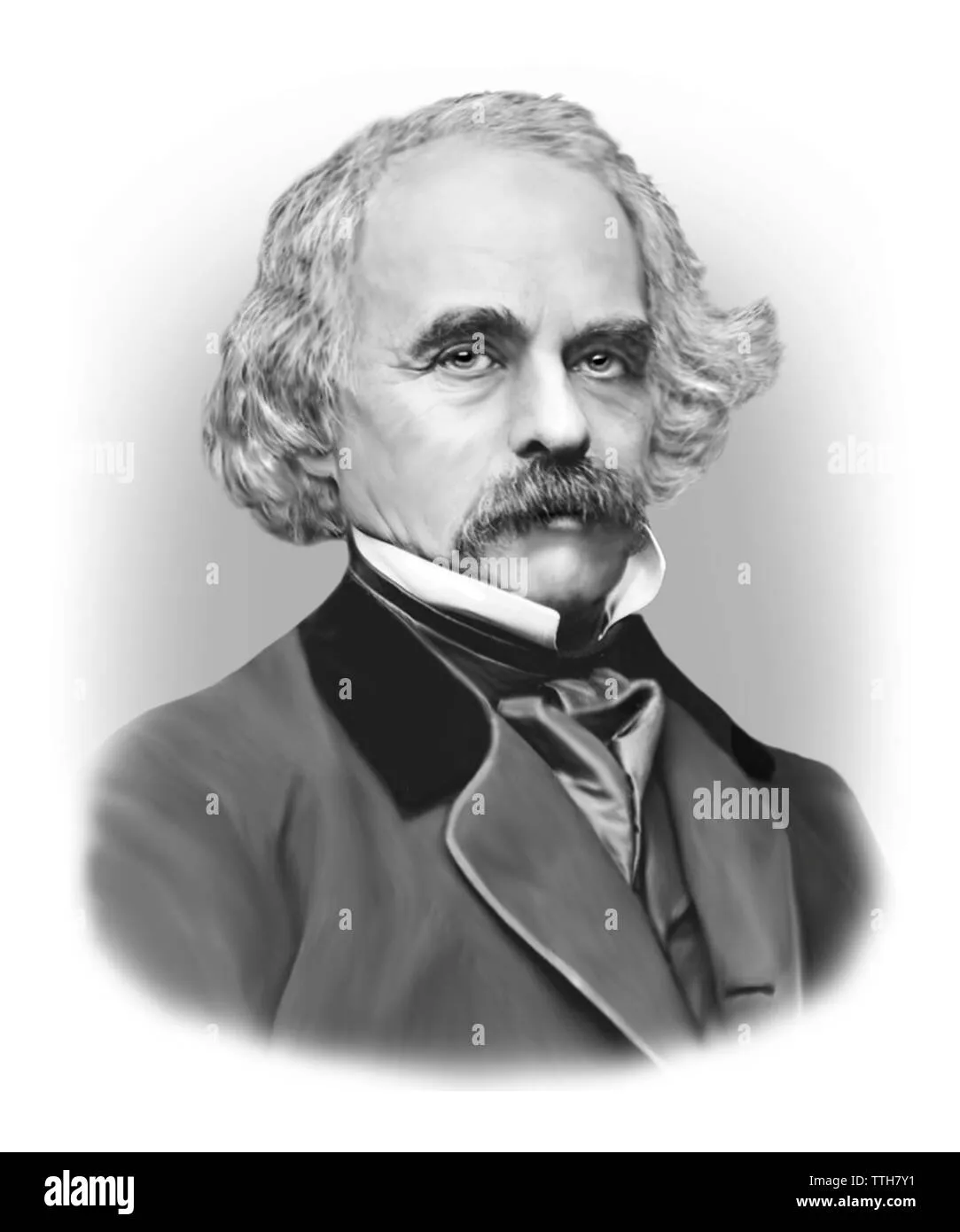 Photo: Nathaniel Hawthorne, via c8.alamy.com
For the next twelve years, Hawthorne lived like a ghost in his own life. He rarely left the house during daylight hours, taking solitary walks only after dark through the streets of Salem. His neighbors whispered about the strange young man who seemed to have given up on everything. His college classmates, including future president Franklin Pierce, were building careers and families while Hawthorne remained invisible.
To the outside world, these were his lost years. To American literature, they were everything.
The Fire That Almost Wasn't
Sometime around 1829, Hawthorne did something that would make any writer's heart stop: he gathered up nearly everything he had written during his first four years of isolation and burned it. Stories, sketches, attempts at novels — all of it went into the flames of his fireplace.
Among the manuscripts he destroyed was his first novel, "Fanshawe," which he had published anonymously in 1828. The book had received little attention, and Hawthorne was so ashamed of it that he tried to buy up and destroy every copy he could find. For decades, scholars thought the work was lost forever.
But here's what makes Hawthorne's story so extraordinary: that act of destruction wasn't self-sabotage. It was artistic courage. He wasn't burning his work because he thought he was a failure — he was burning it because he knew he could do better.
The Laboratory of Loneliness
While Salem gossiped about the hermit in the Hawthorne house, something remarkable was happening in that third-floor room. Hawthorne was conducting an experiment in consciousness that no writing workshop could have taught him.
He read voraciously — Shakespeare, Milton, Bunyan, the Gothic novelists. But more importantly, he was learning to see the darkness that lurked beneath New England's pristine surface. Growing up in Salem, with its witch trial legacy and Puritan ghosts, he was perfectly positioned to understand that America's past wasn't the noble story most people wanted to tell.
His isolation wasn't escapism; it was archaeology. He was digging into the buried conscience of a nation.
The Breakthrough Nobody Saw Coming
In 1837, twelve years after retreating to his attic, Hawthorne published "Twice-Told Tales." The collection of short stories was unlike anything American readers had encountered. Where other writers of the era favored optimistic tales of progress and possibility, Hawthorne offered psychological complexity and moral ambiguity.
Stories like "Young Goodman Brown" and "The Minister's Black Veil" explored the hidden guilt and hypocrisy of Puritan New England with a sophistication that seemed to come from nowhere. Critics were baffled by the sudden appearance of this mature, fully-formed literary voice.
But Hawthorne's voice hadn't appeared suddenly. It had been forged in silence, shaped by solitude, and refined by the kind of deep introspection that's impossible in the noise of normal social life.
The Wrong Path to Literary Immortality
By conventional standards, Hawthorne had wasted the most productive years of his life. While his contemporaries were climbing career ladders and establishing themselves in society, he had chosen invisibility. When he finally emerged, he was 33 years old with little to show for his adult life except a handful of stories that most people ignored.
Yet those "wasted" years had given him something irreplaceable: a perspective that no amount of networking or professional development could have provided. His isolation had taught him to see into the human heart with surgical precision.
When "The Scarlet Letter" was published in 1850, it became an immediate sensation. Here was an American novel that could stand alongside the greatest works of European literature. The psychological realism, the symbolic complexity, the unflinching examination of guilt and redemption — none of it would have been possible without those twelve years of apparent failure.
The Genius of Getting Lost
Hawthorne's story challenges everything we think we know about success and productivity. In our age of constant networking and personal branding, his path seems almost incomprehensible. Who disappears for twelve years? Who burns their early work? Who chooses solitude over society?
But perhaps that's exactly why his story matters. Hawthorne understood something that our hyperconnected world has forgotten: sometimes the most important work happens in silence, away from the crowd, in the spaces where society can't reach.
His twelve-year retreat wasn't a detour from his destiny — it was the only road that could have led him there. The writer who emerged from that Salem attic had been forged by solitude into something uniquely American: an artist capable of seeing both the light and shadow of the national soul.
In a culture obsessed with early achievement and visible progress, Nathaniel Hawthorne reminds us that some paths to greatness can't be rushed, can't be networked, and can't be optimized. Sometimes you have to get lost before you can find what you're really looking for.