The Librarian Who Never Graduated: How Melvil Dewey Built the System That Organizes America's Mind
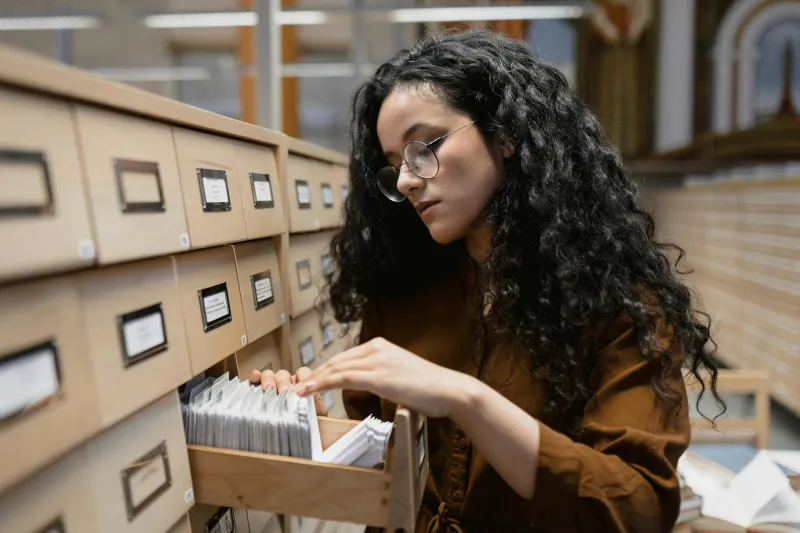
The Rebel in the Reading Room
Walk into almost any library in America, and you'll find books arranged by a simple three-digit code. 796.357 for baseball. 641.5 for cooking. 973 for American history. It's so universal, so logical, that it feels like it must have always existed—like the alphabet or the calendar.
But this system that quietly organizes millions of books and billions of thoughts came from one of the most disorganized minds in academic history. Melvil Dewey was a college dropout, a serial entrepreneur who burned bridges faster than he built them, and a man whose personal life was so chaotic that he spent decades fleeing creditors and controversies.
Yet somehow, this restless outsider created the organizational framework that would become the backbone of American intellectual life. His story isn't just about libraries—it's about how the most unlikely people sometimes build the most essential systems.
The Student Who Couldn't Sit Still
Dewey arrived at Amherst College in 1870 with the kind of manic energy that either produces genius or complete disaster. While his classmates focused on their studies, Dewey was already obsessed with efficiency and organization. He simplified his name from Melville to Melvil, dropped unnecessary letters from common words ("catalog" instead of "catalogue"), and constantly tinkered with ways to make everything faster and better.
But college couldn't contain his ambitions. Dewey dropped out before graduation, leaving behind a trail of unpaid debts and frustrated professors. Traditional academic paths felt too slow, too rigid for someone who saw inefficiency everywhere and believed he could fix it all.
While his former classmates collected their diplomas, Dewey was already working as a student assistant in Amherst's library, staring at thousands of books arranged in the most haphazard ways imaginable. Some libraries organized by size. Others by color. Most just shoved new books wherever they fit.
For a mind obsessed with order, it was torture. And opportunity.
The Decimal Revolution
In 1876, at just 25 years old, Dewey published a slim pamphlet that would reshape how America organized knowledge. His "Classification and Subject Index" introduced a radical idea: organize all human knowledge into ten main classes, each divided into ten divisions, each subdivided into ten sections.
000-099: Computer science and general knowledge
100-199: Philosophy and psychology
200-299: Religion and theology
300-399: Social sciences
400-499: Language
500-599: Pure sciences
600-699: Technology
700-799: Arts and recreation
800-899: Literature
900-999: History and geography
It sounds simple now, but it was revolutionary then. For the first time, every book could have a precise numerical address. A patron in Boston could ask for book 641.5973, and a librarian in San Francisco would know exactly what they meant—American cooking.
Librarians initially resisted. The system seemed too complicated, too mathematical for institutions built on tradition and scholarly intuition. But Dewey had something his critics lacked: relentless persistence and an unshakeable belief that his way was better.
The Entrepreneur Who Couldn't Stay Put
Success didn't calm Dewey down—it energized him. He founded the Library Bureau, selling card catalogs and filing systems to libraries across America. He established the first library school at Columbia College, training a generation of professional librarians. He co-founded the American Library Association and launched Library Journal, the profession's first major publication.
But Dewey's brilliance came packaged with chaos. He was a serial entrepreneur who started dozens of ventures, most of which failed spectacularly. He promoted spelling reform so aggressively that he alienated colleagues. His business practices were questionable at best—he routinely overpromised, underdelivered, and left partners holding empty bags.
Personal scandals followed him everywhere. He faced accusations of financial impropriety, inappropriate behavior with female employees, and anti-Semitic policies at his exclusive Lake Placid Club. By the 1890s, he had been forced out of Columbia and was persona non grata in many professional circles.
The System That Outlasted Its Creator
While Dewey's reputation crumbled, his decimal system thrived. Libraries across America adopted it because, despite its creator's flaws, it simply worked. The system was flexible enough to accommodate new fields of knowledge, precise enough to handle millions of books, and logical enough that ordinary people could navigate it without training.
By the early 1900s, the Dewey Decimal Classification had become the de facto standard for American libraries. It spread internationally, organizing knowledge in dozens of countries and multiple languages. Today, more than 200,000 libraries worldwide use Dewey's system to manage over 2 billion items.
The man who couldn't finish college had created the organizational framework for higher education. The dropout who clashed with every institution had built a system that institutions couldn't live without.
The Chaos Behind the Order
Dewey died in 1931, still promoting various schemes and reforms, still burning bridges and chasing new obsessions. But his decimal system had already achieved something its creator never could: perfect stability. While Dewey's life was marked by constant upheaval, his classification system provided the steady foundation that allowed American libraries to grow from small collections to massive repositories of human knowledge.
There's something beautifully ironic about this legacy. The man who brought mathematical precision to library science was himself utterly unprecise in business and relationships. The person who created perfect order lived in perpetual chaos. The outsider who never fit into academic institutions built the system that academic institutions couldn't function without.
The Wrong Path to the Right Place
Dewey's story challenges our assumptions about how important innovations happen. We expect groundbreaking systems to come from distinguished professors or established institutions. We assume that people who create lasting order must themselves be orderly.
But sometimes the most essential tools come from the most unlikely sources. Sometimes the people who can't follow existing systems are exactly the ones we need to build better ones. Sometimes the wrong path—dropping out, burning bridges, refusing to conform—leads to exactly the right destination.
Every time you walk into a library and find exactly the book you need, you're benefiting from the obsessions of a college dropout who couldn't sit still. Every time knowledge feels accessible and organized, you're experiencing the legacy of someone who lived in beautiful, productive chaos.
Melvil Dewey never graduated, but he educated America. He never mastered his own life, but he mastered the organization of human knowledge. And in the quiet efficiency of libraries across the country, his chaotic genius lives on—perfectly ordered, precisely cataloged, exactly where it belongs.